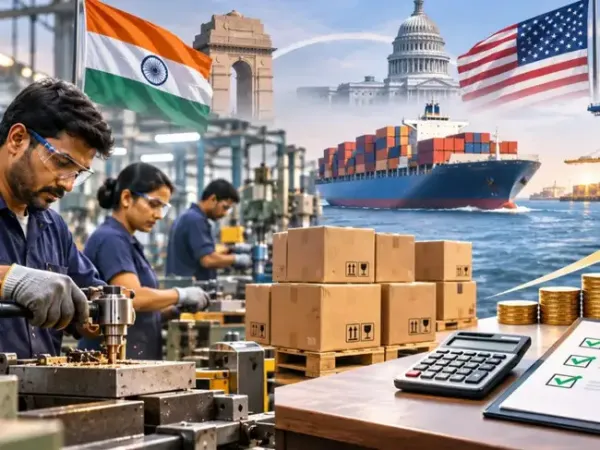
Indian exporters face uncertainty with the US's new Section 301 tariffs, raising red flags for several sectors. The textile industry identifies new opportunities, while engineering exporters express concerns about competitiveness. Seafood exporters are pivoting towards alternative markets in response to potential threats from Ecuador.
India’s exporters are bracing for another spell of uncertainty in the US market after Washington proposed additional duties of up to 25% on Indian goods under its Section 301 investigation into structural excess capacity in manufacturing. The proposed rate could come down to 17% if New Delhi reaches a reciprocal trade agreement with Washington that addresses the US concerns. However, industry representatives say the threat of fresh duties is already weighing on business planning, buyer negotiations, and export strategies.
The proposed action is yet to be finalised, and no new duties have come into effect so far. The US Trade Representative (USTR) has invited written comments until January 5, 2027, and scheduled public hearings to begin from January 25. The USTR will then consider the submissions before deciding on the proposed measures.
The proposal has drawn mixed reactions from Indian industry, with its potential impact varying across sectors based on their exposure to the US market and the competitive pressures exporters face. The Economic Times Digital spoke to industry representatives across sectors to understand how the proposed duties may impact exporters and their businesses.
Textile exporters flag order uncertainty, see opportunity in trade deal
The domestic textile and apparel industry is concerned that frequent changes in US tariff policy could disrupt commercial negotiations and order flows.
Chandrima Chatterjee, Secretary General of the Confederation of Indian Textile Industry (CITI), said frequent changes in tariff policies and regulations create considerable uncertainty for exporters and their overseas buyers. “Such changes are difficult to accommodate in ongoing commercial negotiations, pricing arrangements, and buyer commitments, particularly in the textile and apparel sector, where orders are often negotiated and finalised well in advance of shipment,” she said.
However, CITI sees a potential opportunity if India manages to secure the proposed 17% rate through a trade agreement with the US. Chatterjee said this could place Indian textile and apparel exporters in a relatively favourable position against selected competing Asian economies facing rates of 18-20%.
Sanjay K. Jain, Chairman of the National Experts Committee on Textiles of the Indian Chamber of Commerce and Managing Director of TT Textiles, said the ongoing negotiations may bring some clarity over the next two months. He believed the final rate may not exceed 17%; however, he acknowledges that the outcome remains uncertain. “Luckily, we are not at a disadvantage against our competitors like China, Bangladesh, Indonesia, Thailand, and Vietnam. Hopefully, if a proper trade agreement is made, we’ll be at a relative advantage to them,” said Jain. However, he cautioned that uncertainty was already affecting fresh orders, with buyers adopting a wait-and-watch approach. “The instability and uncertainty always affect order flow. People keep waiting; only emergency orders come,” he added.
Engineering exporters question tariff advantage
Engineering exporters have questioned whether a potential 17% tariff rate would give India a meaningful competitive advantage, pointing to lower proposed rates for several other major trading partners.
Pankaj Chadha, Chairman of the Engineering Export Promotion Council of India, said the government’s stated position has been to secure a competitive advantage for India over neighbouring countries and other competing economies through a trade agreement with Washington. However, a 17% rate through trade agreement, he said, would offer only a marginal advantage over countries such as Bangladesh, Indonesia, Malaysia, and Thailand, which face proposed rates of around 18%.
He also pointed to the potential tariff disadvantage Indian exporters could face against competitors in economies such as the European Union (EU), Japan, South Korea, Taiwan, and Switzerland, for which the US has proposed rates of around 15%, subject to the applicable tariff calculations. “If India is at 17% under a trade deal with the US, I am not entirely sure that gives us a significant competitive advantage,” Chadha said, adding that India’s competitiveness would ultimately depend on how its tariff rates compare with those faced by competing countries.
“As long as India and its competing countries are facing the same tariff rates, there are no issues. But if our competitors end up with lower tariffs than India, there is significant concern,” he said.
The concerns come at a time when Indian engineering exports are gaining traction in the US market. According to EEPC India’s data, engineering exports to the US rose 62% year-on-year in October 2026. During April-October, shipments grew 26.1%, with the US accounting for around 17.2% of India’s total engineering exports.
Chadha said it was too early to assess the impact on exporters as negotiations were continuing and the final tariff structure remained uncertain.
Livestock sector seeks safeguards
The livestock and allied sectors have called for safeguards in India’s trade negotiations with the US, while emphasising the need to diversify export destinations amid changing global tariff regimes. Sumit Sureka, Chairman of the Compound Livestock Feed Manufacturers Association of India (CLFMA of India), said the proposed duties could affect the price competitiveness of Indian products in the US market, depending on the products covered and the final tariff structure. “We hope the government will ensure that the interests of the complete livestock sector—poultry, dairy, and aquaculture—are adequately safeguarded,” he said.
Sureka also called on exporters to explore opportunities in Southeast Asia, the Middle East, and Africa, where demand for Indian animal protein and allied products could be developed further. He said existing and upcoming trade agreements, including the India-UK FTA and proposed India-EU FTA, could help Indian businesses secure preferential market access and reduce dependence on individual markets. The long-term focus, he says, should be on building a diversified export ecosystem through stronger trade partnerships, improved quality and traceability standards, and greater global competitiveness.
Seafood exporters flag Ecuador threat
The seafood export industry has flagged the risk of losing competitiveness to Ecuador, India's principal rival in the US shrimp market, if the proposed duties are implemented.
K.N. Raghavan, Secretary General of the Seafood Exporters Association of India, said the proposed tariffs could give Ecuador an advantage over Indian exporters. He said the industry was also looking to diversify its export markets in response to repeated tariff-related uncertainty in the US.
Raghavan said Indian seafood exporters were moving away from dependence on a single product, species, and market. “We are also in the process of diversifying from one product, one species, one market.”
He said Indian seafood exporters were exploring opportunities in markets such as the European Union, Japan, China, and Vietnam. The diversification strategy, he said, helped the sector navigate the turbulent phase triggered by US President Donald Trump’s tariff actions.
Pharma sees limited impact
India’s pharmaceutical exports to the US stood at $9.46 billion in FY26, making it the country’s largest export market and accounting for 30.4% of India's total pharmaceutical exports. According to the US Trade Representative, Indian companies account for up to 47% of generic prescriptions dispensed in the US and 61% of generic solid oral drug doses. Namit Joshi, Chairman of the Pharmaceuticals Export Promotion Council of India (Pharmexcil), told The Economic Times Digital that the industry remained relatively insulated from the latest developments, with the Section 301 findings still at a preliminary stage. “At this point, we do not see an immediate concern for the Indian pharmaceutical industry,” he said, adding that the council would continue to monitor developments.
Policy calls for sectoral support and MSME relief
Offering a broader policy perspective, Ajay Srivastava, Founder of the Global Trade Research Initiative (GTRI), called for a sector-wise response to the US actions. In its November 25 report, the think tank said, “India must reject the trade deal and instead answer the allegations sector by sector.” GTRI has also cautioned against accepting a trade arrangement that requires unilateral concessions in exchange for tariff relief. In its recommendation, GTRI said that India should “defend its industrial expansion sector by sector as serving legitimate domestic, export, and future demand.”
The development’s potential exposure extends across several labour-intensive export segments where India has significant dependence on the US market. These include apparel and made-up textiles, gems and jewellery, marine products, leather goods, footwear, carpets and handicrafts, besides auto components and engineering products.
NITI Aayog’s Trade Watch report, using 2024 ITC Trade Map data, shows that the US accounted for nearly 49% of India’s total exports of made-up textile articles. Its share stood at 34.4% for knitted apparel and 31.6% for non-knitted apparel. Gems and jewellery also had a US export share of around 31%. These export categories have a significant presence of smaller manufacturers and production clusters, making tariff uncertainty relevant for MSMEs across the value chain. Against this backdrop, Vinod Kumar, president of the India SME Forum, has urged smaller exporters to consult their US buyers before revising quotations or offering price concessions. He said businesses should first assess the potential impact on individual products and prioritise orders for which raw materials have already been purchased or production has begun.
“Our advice to MSME exporters is to speak to your US buyers before revising a single quotation,” Kumar said. He also called on the Department of Commerce to work with export promotion councils and industry associations to identify orders at risk, the jobs dependent on them and products requiring specific relief.
Kumar suggested that the Directorate General of Foreign Trade (DGFT) provide exporters with product-wise guidance on the proposed US duties and mobilise India's commercial missions to identify additional buyers for affected clusters.
The Central Board of Indirect Taxes and Customs (CBIC), he said, could expedite eligible GST refunds and duty drawback claims to ease cash-flow pressures on smaller manufacturers. “A timely refund can help several SMEs meet their next wage bill,” Kumar said, highlighting the importance of working capital for smaller manufacturers navigating uncertainty.
Kumar also urged the government to protect existing MSME export commitments through suitable transition measures and product-specific relief. “While negotiations continue, agree on transition arrangements for goods already in transit or in production against confirmed orders, and consider targeted exemptions where Indian MSMEs supply products that American buyers cannot readily replace. That would protect jobs in Indian clusters and give US businesses continuity of supply,” he added.