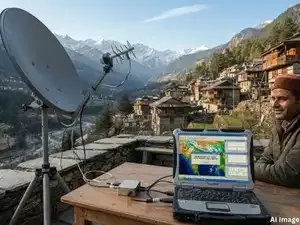
Elon Musk has a class 12 competitor from India: Hyderabad student makes satellite receiver that works without internet (AI image)
When heavy rain disrupts mobile networks in the Himalayas, residents of remote villages can lose access to crucial weather-related information just when they need it most. A Class 12 student from Hyderabad has developed a satellite-based device that can receive cloud images directly from weather satellites without requiring an internet connection or mobile network.
Named SummitSathi, the receiver has been developed by Aagam Jain, a student of Indus International School. The device uses readily available components and costs approximately Rs 68,000 per unit. Three such receivers are planned for deployment across 10 villages in Himachal Pradesh's Seraj Valley in Mandi district, according to The Hans India.
The project aims to provide communities in mountainous areas with an additional source of weather-related information when conventional communication networks become unreliable, particularly during the monsoon.
Also Read: Just days before turning 13, teenager started a tomato business; now grows 7,000 plants and has customers as far as Australia
Connectivity remains a challenge in remote Himalayan settlements because of their difficult terrain and geographical isolation. Heavy rainfall can further disrupt communication networks and roads, making it harder for residents to access timely information.
SummitSathi is designed to address part of this problem by providing access to satellite imagery without depending on mobile data or internet services.
Three local operators have already been trained to use the receivers, allowing communities to access the technology without depending entirely on outside technical assistance.
Each unit costs approximately Rs 68,000 and is built using available components, making the project relatively affordable compared with more complex infrastructure-based solutions.
SummitSathi does not predict cloudbursts or replace official weather alerts
The team behind the project has clarified that SummitSathi is not a cloudburst prediction system. It does not replace official weather forecasts, warnings or emergency alerts.
Instead, the receiver provides an additional source of weather-related information through satellite imagery. Its purpose is to help communities access visual information about cloud conditions when regular communication channels are disrupted.
Also Read: Surat student wins prize for tool that predicts groundwater
Over 24 months, he recorded night-sky brightness at 25 locations across Hyderabad to compile data for studying urban light pollution. He has also self-published an astrophotography book titled A Window to the Universe.
With SummitSathi, Aagam has applied his interest in science and research to a practical challenge faced by communities in remote mountain regions.
Named SummitSathi, the receiver has been developed by Aagam Jain, a student of Indus International School. The device uses readily available components and costs approximately Rs 68,000 per unit. Three such receivers are planned for deployment across 10 villages in Himachal Pradesh's Seraj Valley in Mandi district, according to The Hans India.
The project aims to provide communities in mountainous areas with an additional source of weather-related information when conventional communication networks become unreliable, particularly during the monsoon.
Also Read: Just days before turning 13, teenager started a tomato business; now grows 7,000 plants and has customers as far as Australia
How a Class 12 student developed a satellite receiver that works without internet
Unlike conventional weather applications that depend on internet connectivity, SummitSathi receives cloud images directly from passing weather satellites. This allows users to access satellite imagery even when mobile networks are unavailable or internet services are disrupted.Connectivity remains a challenge in remote Himalayan settlements because of their difficult terrain and geographical isolation. Heavy rainfall can further disrupt communication networks and roads, making it harder for residents to access timely information.
SummitSathi is designed to address part of this problem by providing access to satellite imagery without depending on mobile data or internet services.
Three SummitSathi receivers planned for 10 villages in Himachal Pradesh
The project plans to install three receivers across 10 villages in Seraj Valley, located in Himachal Pradesh's Mandi district. The initiative also includes training local residents to operate the equipment.Three local operators have already been trained to use the receivers, allowing communities to access the technology without depending entirely on outside technical assistance.
Each unit costs approximately Rs 68,000 and is built using available components, making the project relatively affordable compared with more complex infrastructure-based solutions.
SummitSathi does not predict cloudbursts or replace official weather alerts
The team behind the project has clarified that SummitSathi is not a cloudburst prediction system. It does not replace official weather forecasts, warnings or emergency alerts.
Instead, the receiver provides an additional source of weather-related information through satellite imagery. Its purpose is to help communities access visual information about cloud conditions when regular communication channels are disrupted.
Also Read: Surat student wins prize for tool that predicts groundwater
Aagam Jain's research in astronomy and environmental studies
SummitSathi is not Aagam's only independent scientific project. The Class 12 student has also pursued research in astronomy and environmental studies.Over 24 months, he recorded night-sky brightness at 25 locations across Hyderabad to compile data for studying urban light pollution. He has also self-published an astrophotography book titled A Window to the Universe.
With SummitSathi, Aagam has applied his interest in science and research to a practical challenge faced by communities in remote mountain regions.