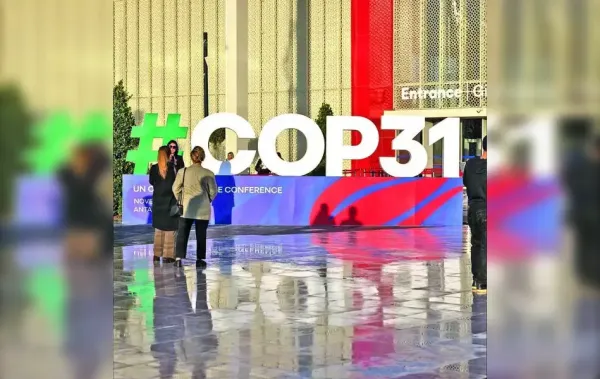
Antalya: Mobilising $1.3 trillion annually in climate finance for developing countries by 2035 is achievable, but will require a fundamental overhaul of the global climate finance system, according to a report prepared by Brazil's COP30 presidency.
"The goal is within reach, but business as usual will not get us there," Ana Toni, chief executive of COP30, said at the UN Climate Change Conference (COP31) in Antalya. If countries continue with their current policies, financial flows will only reach about $460 billion a year - a shortfall of $840 billion, according to the report, Implementing the Baku to Belem Roadmap to 1.3T.
However, overhauling current approaches to deliver a combination of public and private funding, along with targeted tax increases, can unlock between $1.27 trillion and $1.41 trillion a year by 2035, it said. Climate finance is not growing at the necessary pace, and official development assistance has been shrinking, the report said.
Public finance continues to be a core and critical pillar. "We need to put public finance back on the ascending trajectory," said Luis de Andrade Filho, COP30 presidency's climate finance coordinator. The report suggests many policy interventions to that end and estimates how much could be generated from each source.
As per the report, $882 billion a year can be generated from private investments, $351-384 billion from public sources, and $40-144 billion from carbon markets. Innovative sources of finance could generate 68-129 billion annually,it said.These include taxes on the ultrawealthy (35-45 billion), corporate taxes (23-26 billion), financial transaction taxes (2.4-$16 billion), shipping levies (up to $6 billion) and smaller amounts from taxes on air travel, digital services and fossil fuels.
Implementing these measures would be politically challenging, but is necessary to close the financing gap, the report said. This is the final output from the COP30 Brazilian presidency. Earlier, it released two roadmaps - on transitioning away from fossil fuels and on halting deforestation. The finance report is a critical companion to enable developing countries to implement the roadmaps. It is in keeping with COP30 president Andre Correa do Lago's approach that "the climate agenda is a development agenda" and that "the transition cannot create or deepen inequalities."
At the end of contentious negotiations in Baku, developing countries were disappointed with the $300 billion a year that developed countries would be obligated to provide to developing countries. That sum reflects a fraction of their needs. However, developed countries were unwilling to commit a higher sum, citing competing demands, domestic political compulsions and shrinking budgets. Hence, besides the $300 billion commitment, another "at least $1.3 trillion" was set as an additional target that would be drawn "from all private and public sources," including South-South flows.