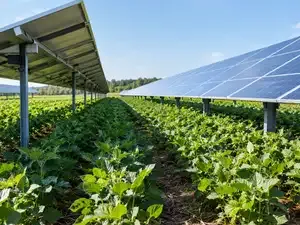
Representative AI image of sustainable farming practices combining renewable energy with productive agricultural land. Image Credits: ChatGPT.
For farmers, solar panels have long represented both an opportunity and a dilemma. They can provide a new source of clean electricity and farm income, but conventional solar installations can also take productive agricultural land out of cultivation. Agrivoltaics attempts to solve that problem by placing photovoltaic panels above or alongside crops, allowing the same land to produce food and energy.
According to Rutgers University, the first 2024 soybean harvest at its southern New Jersey agrivoltaics site found no statistically significant yield difference between the single-panel and double-panel solar designs. Both systems, however, recorded higher yields than the unpanelled control plots. The experiment suggests solar panels and soybean crops can share the same land without necessarily reducing output. Rutgers cautioned, however, that the results were preliminary, based on a single growing season, and required further testing.
A field designed for both crops and electricity
The experiment was carried out at the Rutgers Agricultural Research and Extension Centre (RAREC), located in Upper Deerfield in southern New Jersey. Scientists sowed soybean variety AG42XF1 on 11 June 2024 after a rye cover crop planted in the autumn of the previous year. The planting density was around 160,000 seeds per acre, and similar management practices were employed for all experimental conditions. The experimental field comprised three treatments: traditional land with no panels, one-row solar panel treatment, and two-panel treatment.
The solar panels in the facility were single-axis trackers which were arranged in a north-south alignment and could track the position of the sun during the course of the day. The rows were spaced 34 feet apart, leaving enough room to grow soybeans and use the necessary equipment. The system employed bifacial 450-watt panels where the pivot point was around eight feet above the ground. The capacity of the solar system at this larger research facility was 255 kilowatts, along with 567 panels. This design was important because agrivoltaics is more than simply growing crops in the shade.
The harvest produced an unexpected result.
The harvesting was done in November, when the team used a small combine to harvest the crops from the eastern, central, and western parts of the subplots. In this way, the team could see if there was any difference in the crop based on its positioning in relation to the panels. The difference among the three treatments was statistically significant. Soybeans that grew underneath the single panel as well as the double panel recorded higher yield than the control plot.
The researchers reported average soybean yields of 2.52 tonnes per hectare under the single-panel system and 2.11 tonnes per hectare under the double-panel system, compared with 1.65 tonnes per hectare in the control. However, the difference in yield between the two solar-panel designs was not statistically significant. This suggests that adding more panels over farmland does not always hurt crop performance. In this experiment, the single-panel and double-panel systems did not reduce yield. There was no significant difference in protein-plus-oil content or moisture content in the soybeans.
 Why one year is not enough
There were, however, some caveats regarding the experiment at Rutgers. Southern New Jersey was unusually dry in 2024. Rutgers reports that rainfall amounts were less than two inches between 1 August and the end of the season at the research station. Thus, irrigation had to be provided for the soybean plots in question. This matters when interpreting the results. An irrigation system that works in an unusually dry year may produce different results under other conditions.
Agrivoltaic systems do not produce the same results in every setting. A recent study in npj Sustainable Agriculture, for instance, found that the conventional soybean yield in the agrivoltaics system was 31% less compared to that of its open-field counterpart, thus demonstrating the impact of panel arrangement, climate conditions, management and crop reaction on the difference in the results. Rutgers is treating the project as a starting point and plans to keep testing it further. The experiment is important because it offers a cautionary note. If future harvests confirm these results, agrivoltaics could help farmers use the same land for both crops and energy.
According to Rutgers University, the first 2024 soybean harvest at its southern New Jersey agrivoltaics site found no statistically significant yield difference between the single-panel and double-panel solar designs. Both systems, however, recorded higher yields than the unpanelled control plots. The experiment suggests solar panels and soybean crops can share the same land without necessarily reducing output. Rutgers cautioned, however, that the results were preliminary, based on a single growing season, and required further testing.
A field designed for both crops and electricity
The experiment was carried out at the Rutgers Agricultural Research and Extension Centre (RAREC), located in Upper Deerfield in southern New Jersey. Scientists sowed soybean variety AG42XF1 on 11 June 2024 after a rye cover crop planted in the autumn of the previous year. The planting density was around 160,000 seeds per acre, and similar management practices were employed for all experimental conditions. The experimental field comprised three treatments: traditional land with no panels, one-row solar panel treatment, and two-panel treatment.
The solar panels in the facility were single-axis trackers which were arranged in a north-south alignment and could track the position of the sun during the course of the day. The rows were spaced 34 feet apart, leaving enough room to grow soybeans and use the necessary equipment. The system employed bifacial 450-watt panels where the pivot point was around eight feet above the ground. The capacity of the solar system at this larger research facility was 255 kilowatts, along with 567 panels. This design was important because agrivoltaics is more than simply growing crops in the shade.
The harvest produced an unexpected result.
The harvesting was done in November, when the team used a small combine to harvest the crops from the eastern, central, and western parts of the subplots. In this way, the team could see if there was any difference in the crop based on its positioning in relation to the panels. The difference among the three treatments was statistically significant. Soybeans that grew underneath the single panel as well as the double panel recorded higher yield than the control plot.
The researchers reported average soybean yields of 2.52 tonnes per hectare under the single-panel system and 2.11 tonnes per hectare under the double-panel system, compared with 1.65 tonnes per hectare in the control. However, the difference in yield between the two solar-panel designs was not statistically significant. This suggests that adding more panels over farmland does not always hurt crop performance. In this experiment, the single-panel and double-panel systems did not reduce yield. There was no significant difference in protein-plus-oil content or moisture content in the soybeans.
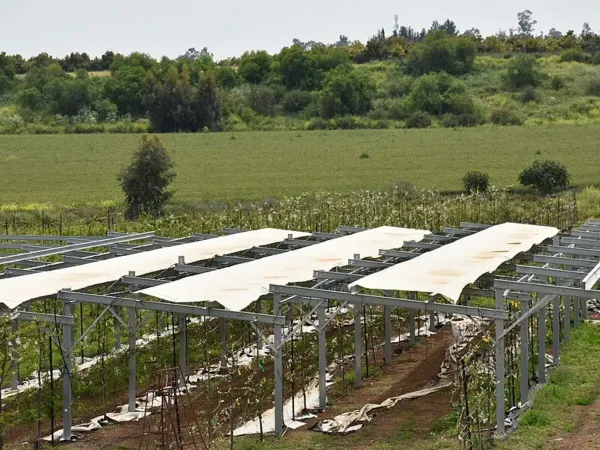
Rutgers University recently performed a groundbreaking experiment on agrivoltaics to assess soybean yield productivity beneath solar panels. Image Credits: Wikimedia Commons.
There were, however, some caveats regarding the experiment at Rutgers. Southern New Jersey was unusually dry in 2024. Rutgers reports that rainfall amounts were less than two inches between 1 August and the end of the season at the research station. Thus, irrigation had to be provided for the soybean plots in question. This matters when interpreting the results. An irrigation system that works in an unusually dry year may produce different results under other conditions.
Agrivoltaic systems do not produce the same results in every setting. A recent study in npj Sustainable Agriculture, for instance, found that the conventional soybean yield in the agrivoltaics system was 31% less compared to that of its open-field counterpart, thus demonstrating the impact of panel arrangement, climate conditions, management and crop reaction on the difference in the results. Rutgers is treating the project as a starting point and plans to keep testing it further. The experiment is important because it offers a cautionary note. If future harvests confirm these results, agrivoltaics could help farmers use the same land for both crops and energy.