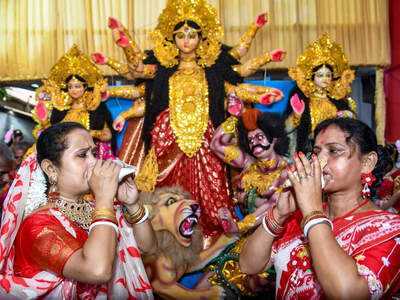
It is that time of year when Bengal and Bengalis erupt in joy at the homecoming of their favourite daughter, en famille. Outside Bengal, the diaspora has preserved links to the homeland through very classic celebrations. Ma Durga is invariably welcomed in Her traditional form, with both the religious and cultural parts of the annual celebrations following time-tested precepts. Many Bengalis within Bengal, however, have taken a distinctly different approach.
The famed creativity of Bengalis is very much in evidence at this pre-eminent religio-cultural festival. In recent decades, artists and visualisers have been tapped to create modern settings and contexts to act as foils to the traditional Bengali clay craftspeople's portrayals of Ma Durga and her divine brood comprising , , and Kartik and their animal mounts, not to mention the fearsome vanquished buffalo demon at her holy feet.
The trend of contemporising or contextualising Ma Durga should be seen as continuations of the personal interaction Bengalis always had with Her. A parallel can be seen in the Ganpati celebrations in Maharashtra whose settings also often address urgent current issues including the environment and social evils or depict important recent events. Crucially, both festivals draw public attention to eco-friendly practices in idol-making and the construction of the pandals.
Visiting some of the innumerable puja pandals of this year, it was impossible not to be struck by the sheer diversity of imagination displayed by those tasked with creating contemporary contexts for Ma Durga. They are a far cry from the time when variations were simple - She and her family were either a single pedestal or set in separate ones. The main difference lay in Ma Durga's mount looking like a lion or more a horse with fangs and moustaches.
Her eyes remained the main focus of her radiant face, invariably elongated and kajal-lined, with tiny veins of red at the corners to show her warrior-goddess-like energy. Her long black tresses, slight smile on her lips and ten arms bearing holy weapons have not only scriptural corroboration but also the stamp of familiarity. This Ma Durga depiction comes in three or four classic casts, some more aquiline and fierce, others more rounded with limpid rather than fervid eyes.
It is a sign of increasing globalisation, perhaps, that many of today's Ma Durgas look more diverse now, at least in Kolkata. In some depictions, her eyes are hazel or honey-coloured, her tresses less dark and crimped, her attire non-traditional. Even her demeanour often seems less that of a vanquishing goddess and more a nurturing mother or a simple 'everywoman'. Whether these forms are conducive to worship rather than just evoking admiration of artistic skills is moot.
Of course, the 'barir pujo' - Ma Durga's homecoming celebrated by families within their homes, often for centuries - remain determinedly classical in their choice of idols whether the celebrants are 'bonedi' (aristocratic) or more modest. 'Sarbojanin' or public community celebrations take a more avant garde approach to depicting Her while the barir pujos are distinguished by the distinct family-specific customs that stem from their personal relationship with Her.
The co-existence of both these 'schools' - classic and contemporary - and devotion and imagination as the twin drivers of the autumnal celebrations of Her homecoming, represent the complementary strands of Kolkata's Durga Puja that decided to recognise as an intangible cultural heritage of India in 2021. Culture is always impacted by time and the human experience, but as long as the core precepts are immutable, these diversities only add to the city's joy.
Contact to : xlf550402@gmail.com
Copyright © boyuanhulian 2020 - 2023. All Right Reserved.