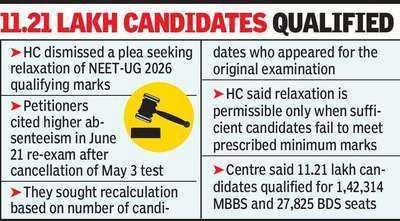
Nagpur: The Nagpur bench of Bombay High Court recently refused to direct Centre to lower the minimum qualifying marks for NEET-UG 2026 , holding that the power to relax the threshold is discretionary and can be exercised only when the condition prescribed under the examination rules is met.
A division bench comprising Justices Anil Kilor and Rajnish Vyas dismissed a petition filed by two NEET-2026 candidates challenging Centre’s Aug 20 communication rejecting their request to recalculate or relax the qualifying marks.
The petitioners argued that out of the 22.79 lakh registered candidates, 22.05 lakh had appeared for the original NEET-UG examination on May 3, which was subsequently cancelled. They said absenteeism was 3.27% during the May exam, which rose to 12.27% in the re-examination on June 21, increasing the percentile because fewer candidates appeared.
They sought recalculation based on the number of candidates who appeared for the original examination. The petitioners contended that the circumstances leading to the cancellation were not attributable to them and that the higher qualifying threshold impaired their ability to pursue medical education.
The court, however, noted that the proviso governing relaxation permits Central govt, in consultation with the relevant medical and other regulatory bodies, to lower the minimum marks only when a sufficient number of candidates in the respective category fail to secure the prescribed minimum marks.
The judges also rejected the argument that the petitioners had an enforceable right to have the qualifying marks reduced. Referring to Supreme Court precedent , they said it requires a legal right and a corresponding legal duty that has not been performed.
The court further considered the petitioners’ contention that they would be unable to pursue medical education abroad because National Medical Commission (NMC) regulations require candidates intending to return and practise in India to meet the NEET eligibility threshold.
The bench said the regulation seeks to maintain a uniform standard for medical education in India and abroad, so that students returning after studying overseas are not subject to a different standard of healthcare training.
Centre told the court that 11.21 lakh candidates had qualified for MBBS/BDS admissions, against 1,42,314 MBBS and 27,825 BDS seats nationwide. It argued that lowering the threshold could affect medical education standards.
The court, relying on earlier Supreme Court and Rajasthan High Court decisions, said judicial review could not be used to substitute the court’s view for an authority’s statutory discretion or to compel a relaxation when the prescribed condition had not arisen.
Contact to : xlf550402@gmail.com
Copyright © boyuanhulian 2020 - 2023. All Right Reserved.