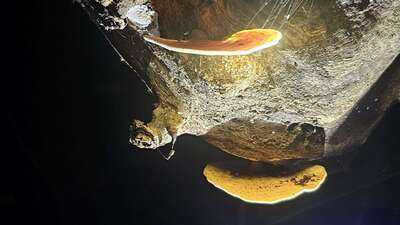
Panaji : The shelf-like bracket fungi on trees are appearing thin, leathery and shrivelled. While a drying mushroom may seem insignificant, fungi are highly sensitive to forest humidity and depend largely on moisture in the air.
“Bracket mushrooms need continuous moisture to grow. Without it, the canopy microclimate can change within hours,” said naturalist Parag Rangnekar . “When moisture levels drop, mushrooms release fewer spores, begin to shrivel and eventually die.”
During steady monsoon spells, mushrooms release millions of microscopic spores, helping maintain populations of forest decomposers. But with a rainfall deficit of more than 35 inches in Goa, many species appear to have stopped fruiting early, conserving energy instead of releasing spores into dry conditions.
“A temporary drop in spore release will not affect forests immediately, but prolonged suppression of fungi can disrupt forest ecology . Without healthy fungal diversity, fallen trees decompose more slowly, reducing the return of organic nutrients to the soil,” Rangnekar said.
Below-average monsoon rainfall could also lower forest water tables earlier than usual, affecting wildlife.
“Frogs depend on monsoon rains to fill seasonal forest pools where they lay eggs. If these pools dry before tadpoles mature, they die,” said naturalist Omkar Dharwadkar . “A decline in frog populations means fewer natural predators of mosquitoes, increasing the risk of diseases such as dengue and malaria .”
Climate scientist and BITS Pilani Goa campus associate professor Rajiv Kumar Chaturvedi said mature trees with deep roots can withstand the rainfall deficit, but young saplings with shallow roots are more vulnerable. “Forests depend on a balance between tree deaths and new growth. Based on monitoring in parts of Goa, we expect lower sapling recruitment this year,” he said.
Chaturvedi said the greater impact may become apparent after the monsoon.
“With a 30% rainfall deficit and erratic monsoon patterns, soils remain insufficiently saturated. This is likely to cause drought stress and affect plant growth cycles. Trees may shed leaves earlier and delay new growth, shortening the period available for photosynthesis. This can reduce growth, flowering and fruiting,” he said.
Chaturvedi said that heat index levels, with “feels-like” temperatures reaching 41°C, indicate that dry conditions have already emerged during the monsoon. “These conditions increase the risk of forest fires and can cause long-term stress to forest ecosystems,” he said.
Contact to : xlf550402@gmail.com
Copyright © boyuanhulian 2020 - 2023. All Right Reserved.