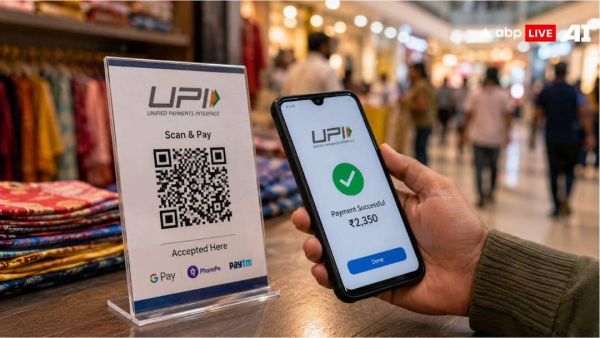
For millions of Indians, scanning a QR code and paying through UPI has become almost second nature. That convenience will continue, but the payment ecosystem behind some of these transactions is set to change from October 15.
The National Payments Corporation of India (NPCI) has introduced a new Merchant Discount Rate (MDR) framework under which eligible person-to-merchant (P2M) UPI transactions above Rs 2,000 will attract a 0.4 per cent fee. The charge will be paid within the merchant-side payments ecosystem and capped at Rs 300 for transactions of Rs 75,000 or more.
For consumers, however, UPI payments will continue to be free under the new framework. Person-to-person transfers will remain outside the MDR regime, while payments of up to Rs 2,000 to merchants will also continue without MDR.
Paying Rs 3,000 To A Shop? Here's What The New Rule Means
The easiest way to understand the change is to look at a typical merchant payment.
If an eligible customer makes a Rs 3,000 UPI payment, the applicable MDR at 0.4 per cent would work out to Rs 12. A Rs 50,000 transaction would attract Rs 200, while the charge would be capped at Rs 300 for payments of Rs 75,000 and above.
The MDR is not a separate fee that UPI users will see added to their payments. NPCI has said consumers will not be charged for using UPI, and UPI apps will not be allowed to levy platform fees or other charges on customers for these transactions.
The government has also advised banks to ensure that the merchant-side cost is not passed on to customers.
Not Every Merchant Will Pay 0.4%
The headline 0.4 per cent rate does not apply uniformly across the UPI ecosystem.
Small vendors covered under the P2PM category will continue to be exempt from MDR. This category covers merchants receiving up to Rs 1 lakh a month through UPI QR payments.
That means the size of an individual transaction alone does not determine whether the merchant falls under the new charge. The merchant's classification and the type of transaction also matter.
Person-to-person payments, such as transferring money to a family member or friend, will also remain free, irrespective of the transaction value.
Some Payments Will Have A Flat Rs 5 Charge
There is also a separate structure for selected sectors.
Transactions above Rs 2,000 in categories including railways, telecom services, insurance and fuel will attract a flat Rs 5 MDR instead of the standard 0.4 per cent rate.
The same treatment extends to certain utility payments, including electricity, municipal water charges and piped natural gas, according to the new framework.
This means a large payment in one of these categories will not automatically result in a percentage-based fee.
Mutual Funds And Stock Market Payments Get A Separate Rate
Payments connected with the capital markets will have a much lower MDR.
The rate has been set at 0.02 per cent, with a maximum charge of Rs 300. The category covers payments involving mutual funds, securities, stockbrokers and dealers, as well as equity purchases, debt-market investments and broker wallet top-ups.
Education-related fee collections will also have a separate structure, with flat-fee or capped processing arrangements for transactions above Rs 2,000, according to NPCI.
UPI AutoPay Escapes The New MDR
Consumers using UPI for recurring payments will not be affected by the prescribed MDR.
NPCI has excluded UPI AutoPay mandates from the new rate. This includes recurring payments such as monthly utility bills, OTT subscriptions and recurring investments.
So, the introduction of MDR does not mean every UPI transaction above Rs 2,000 will suddenly attract a percentage-based charge.
Why Is UPI Getting An MDR Now?
The new framework marks a shift from the zero-MDR model under which UPI merchant transactions have operated since January 2020. The move follows months of discussion around how the rapidly expanding payments ecosystem should fund the infrastructure required to operate and scale it.
An MDR is essentially a fee associated with accepting digital payments. Unlike a tax, the money is distributed among entities involved in processing the transaction rather than being collected by the government as revenue.
These participants include the customer's bank, the merchant's acquiring bank, payment service provider banks, UPI apps and other payment intermediaries.
A New Fund For Smaller Merchants Is Also Planned
Alongside the MDR framework, NPCI plans to create a dedicated fund aimed at expanding digital-payment infrastructure and merchant acceptance in smaller centres.
The proposed initiative will cover Tier III to Tier VI locations, as well as the north-eastern states, Jammu and Kashmir and Ladakh. A source cited in the framework said the fund could receive around Rs 700 crore annually, with the detailed structure expected to be finalised in consultation with the Reserve Bank of India within three months.
The initiative follows the Payments Infrastructure Development Fund scheme, which concluded in December 2025.
What Changes From October 15?
For the average UPI user, the immediate change is limited.
If you pay another person: P2P UPI transactions remain free.
If you pay a merchant up to Rs 2,000: No MDR applies.
If you pay an eligible merchant above Rs 2,000: The merchant-side MDR will generally be 0.4 per cent, subject to the Rs 300 cap.
If you pay certain sectors such as fuel, railways or telecom: A flat Rs 5 MDR will apply to eligible transactions above Rs 2,000.
If you use UPI AutoPay: The prescribed MDR does not apply.
If you pay a small P2PM merchant: The merchant remains exempt under the specified Rs 1 lakh monthly threshold.
The new framework takes effect on October 15, giving banks, payment aggregators, fintech companies and other participants time to update their systems before implementation.
Contact to : xlf550402@gmail.com
Copyright © boyuanhulian 2020 - 2023. All Right Reserved.