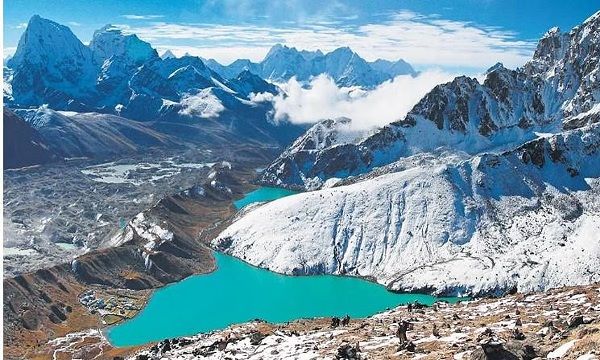
Kathmandu. Floods and landslides in Nepal have once again exposed the sensitivity of the Himalayan regions. The Himalayas, known for their beautiful mountains and valleys, are actually among the most sensitive areas in the world in terms of natural disasters. Here incidents to floods, landslides, cloud bursts, earthquakes and glaciers turn into major crises from time to time.
But why is the risk of disasters so high in the areas adjacent to the Himalayas? Many reasons work together behind this like geological formations, slopes of mountains, heavy rains and rapidly changing climate.
Collision of Indian and Eurasian plates is the major reason
The Himalayas are one of the youngest major mountain ranges in the world. It was formed by the continuous collision of the Indian and Eurasian tectonic plates. The special thing is that the movement of both the plates continues even today.
The constant movement of these plates creates geological stress within the Earth. For this reason, the Himalayan region is technically very active and there is a constant risk of earthquake.
Many parts of India associated with the Himalayas also fall into high seismic risk areas, especially areas included in seismic zones IV and V.
Why does the young structure of the mountains increase the danger?
One consequence of the relatively young geological structure of the Himalayas is that in many places the soils, rocks and sediments are relatively unstable. When there is heavy rain, this material starts sliding down the slopes.
This causes incidents of landslides. When large quantities of soil, stones and debris suddenly come down, roads, bridges and settlements can get affected.
Steep slopes make water dangerous
The terrain of the Himalayas is extremely steep. There are deep valleys and steep slopes here. During heavy rains, instead of staying on the mountains for long, the water flows rapidly downwards and reaches the narrow river valleys.
Strong currents can also carry away rocks, soil, trees and other debris. This process makes flash floods more destructive.
In narrow valleys the velocity of water can increase very rapidly. Its direct impact is on the houses, roads, bridges and other infrastructure built on the river banks.
Climate change increases difficulties
The natural sensitivity of the Himalayas is now being put under additional pressure from climate change. The Himalayas are sometimes called the 'Third Pole' because of the large amount of snow and glaciers present outside the polar regions.
Many glaciers are retreating due to rising temperatures. Along with this, the stability of frozen ground and mountain slopes can also be affected.
When the glacier lake bursts, the devastation intensified
Melting of glaciers can increase the size of the lakes formed around them. If the natural ice, rock or debris wall blocking these lakes breaks due to water pressure, landslide or any other reason, a large amount of water can suddenly flow downstream.
This is called a glacial lake outburst flood (GLOF).
Such floods can cause large-scale devastation in the low-lying valleys in a short time. The danger is especially high in those areas where settlements and infrastructure are built very close to rivers.
Situation can change in few minutes due to cloud burst
Cloud burst in Himalayan areas can also cause sudden major disaster. In this, a lot of rain occurs in a small area in a very short period of time.
Its effect increases manifold in hilly areas. Sudden torrential rains can simultaneously lead to incidents like landslides, debris flows and flash floods.
River levels can rise rapidly and the weight of additional water can destabilize already weak mountain slopes.
Disasters in the Himalayas are not separate, they are linked to each other.
The biggest challenge of the Himalayan regions is that here one natural phenomenon can give rise to another disaster. Heavy rains weaken the slopes, landslides can block the course of the river and the accumulated water can then suddenly release and cause floods. At the same time, breaking of lakes formed due to melting of glaciers can also cause sudden deluge in low-lying areas.
That is, geological activity in the Himalayas, steep slopes, unstable rocks, heavy rains, changes in glaciers and climate change together increase the risk of disaster.
That is why disaster management, early warning systems, safe construction in river valleys and constant monitoring of sensitive areas become extremely important in Nepal, India, Bhutan and other Himalayan regions.
Contact to : xlf550402@gmail.com
Copyright © boyuanhulian 2020 - 2023. All Right Reserved.