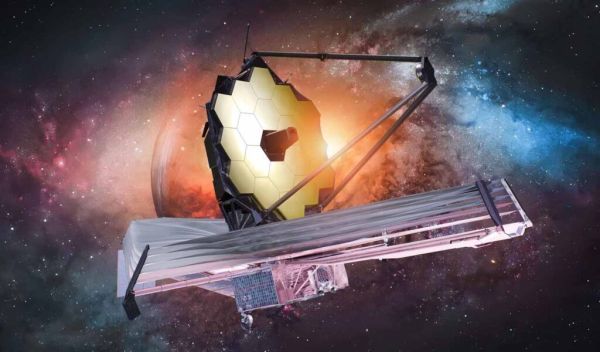
The James Webb Space Telescope’s groundbreaking observations are reshaping our understanding of the cosmos, challenging long-held theories, and opening exciting new frontiers in the search for extraterrestrial life
Published Date – 14 July 2026, 11:08 PM
For millennia, the star-lit sky has fascinated humans and triggered profound questions about the cosmos, the mysteries of its origin, and our place in it. This pursuit may have reached its watershed moment now, thanks to a series of discoveries made by the James Webb Space Telescope (JWST)the most sophisticated ‘window to the universe’ ever built by mankind. On July 12, 2022, the world was treated to the first set of full-colour images beamed back by the JWST, marking the beginning of a new era in astronomy. The images coming from the $10-billion telescope over the last four years have revolutionised our understanding of the early universe, galaxy formation, stellar evolution, black holes, and the atmospheres of distant exoplanets. Its discoveries have challenged long-held theories and opened new frontiers in the search for extraterrestrial life. Jointly developed by NASAthe European Space Agency (ESA), and the Canadian Space Agency (CSA) over three decades, the JWST is humanity’s most ambitious eye in the sky. Peering into the distant past, the telescope has been revealing incredible new details of the early universe. JWST is located 1.5 million kilometres from Earth, well beyond the Moon’s orbit. Here, its giant gold-plated mirror can observe the cosmos unhindered, protected by a tennis court–sized sunshield that blocks our star’s light and heat. All this gives JWST unprecedented sensitivity to some of the faintest wisps of light reaching us from the first few hundred million years when the first stars were kindled, and galaxies coalesced.
The most significant revelation made by the telescope so far is that the early universe grew faster than anyone expected. To the utter surprise of the astronomical community, the JWST images revealed that the early galaxies – formed just 300 to 400 million years after the Big Bang – were not faint and diffuse smudges, as was expected. But they were bright, fully formed, and well-structured systems with stellar masses exceeding what standard galaxy formation models predicted possible at such early epochs. This virtually challenges the standard cosmic model, which says that after the fiery Big Bang 13.8 billion years ago, the universe cooled, and energy turned into matter that eventually coalesced during the first few hundred million years, forming the first generation of stars and galaxies. Most models estimate that a galaxy the size of our Milky Way would not form until roughly 1 billion to 2 billion years after the Big Bang. But, surprisingly, what they found in the images of the early universe were fully formed stars and galaxies. The findings suggest that stars and galaxies were forming far faster than previously believed. The most exciting frontier is the search for habitable worlds. Unlike earlier telescopes, the JWST, with its 6.5-metre mirror, can analyse the chemical composition of exoplanet atmospheres through transmission spectroscopy.
Contact to : xlf550402@gmail.com
Copyright © boyuanhulian 2020 - 2023. All Right Reserved.