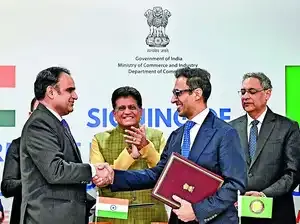
New Delhi: India and the six-nation Gulf Cooperation Council (GCC) Thursday inked terms of reference for starting talks for a Free Trade Agreement (FTA). The West Asian bloc is the largest trading partner of India with bilateral goods trade of $178.56 in FY25.
Saudi Arabia, the UAE, Qatar, Kuwait, Oman and Bahrain are members of the GCC. The terms of reference (ToR) outline the scope and modalities of a proposed trade pact.
Commerce and industry minister Piyush Goyal, who presided over the signing ceremony of the ToRs with the GCC, said that the trade pact brings predictability to policy. It will benefit the petrochemical industry and create opportunities for the ICT industry. "It is most appropriate that we now enter into a much stronger and robust trading arrangement which will enable a greater free flow of goods, services, bring predictability and stability to policy, help encourage a greater degree of investments," Goyal said. The two trading partners have been trading amongst each other for over 5,000 years and about 10 million Indians are living and working in the GCC region.
Launch of FTA talks with the GCC would be a kind of resumption of the negotiations, as the earlier two rounds of negotiations were held in 2006 and 2008 between the two regions. The third round did not happen as GCC deferred its negotiations with all countries and economic groups.
Goyal said the agreement will also encourage the food and energy security of the two sides. While India is a major food grain producer in the world, GCC nations are oil and gas exporters. The minister noted that there is a "very robust" nearly $179 billion bilateral trade, and that Indian exports will get a boost from the proposed pact from the elimination of duties and non-tariff barriers.
"I believe a number of products and services required by the GCC countries can be provided by our young, very talented and skilled Indians, as the GCC countries can help us with further diversification and growth of our energy sources," Goyal said. India has already inked trade pacts with the UAE and Oman in the GCC. The India-UAE Comprehensive Economic Partnership Agreement (CEPA) entered into force on May 1, 2022. India and Oman signed a CEPA in Muscat on December 18, 2025. "We will also get a foothold to grow Indian infrastructure and the infrastructure in the GCC, together with the high-quality companies that are working in the space of infrastructure. Our petrochemical industry will hugely benefit with this partnership," Goyal said.
India finalised as many as nine trade pacts in the last few years, covering 38 developed nations.
GCC's chief negotiator, Raja Al Marzouqi, said the pact is important at a time of global uncertainties. "So it's a message, it's a signal for the whole globe, and it's important for us at this time to try to be more cooperative to avoid any risk that our global economy is facing as a result of uncertainty," he said. Saudi Arabia is India's second largest GCC trade partner after the UAE.
India's key imports from the bloc include crude oil and natural gas while pearls, precious and semi-precious stones, metals, imitation jewellery, electrical machinery, iron and steel, and chemicals are the top exports.
Saudi Arabia, the UAE, Qatar, Kuwait, Oman and Bahrain are members of the GCC. The terms of reference (ToR) outline the scope and modalities of a proposed trade pact.
Commerce and industry minister Piyush Goyal, who presided over the signing ceremony of the ToRs with the GCC, said that the trade pact brings predictability to policy. It will benefit the petrochemical industry and create opportunities for the ICT industry. "It is most appropriate that we now enter into a much stronger and robust trading arrangement which will enable a greater free flow of goods, services, bring predictability and stability to policy, help encourage a greater degree of investments," Goyal said. The two trading partners have been trading amongst each other for over 5,000 years and about 10 million Indians are living and working in the GCC region.
Launch of FTA talks with the GCC would be a kind of resumption of the negotiations, as the earlier two rounds of negotiations were held in 2006 and 2008 between the two regions. The third round did not happen as GCC deferred its negotiations with all countries and economic groups.
Goyal said the agreement will also encourage the food and energy security of the two sides. While India is a major food grain producer in the world, GCC nations are oil and gas exporters. The minister noted that there is a "very robust" nearly $179 billion bilateral trade, and that Indian exports will get a boost from the proposed pact from the elimination of duties and non-tariff barriers.
"I believe a number of products and services required by the GCC countries can be provided by our young, very talented and skilled Indians, as the GCC countries can help us with further diversification and growth of our energy sources," Goyal said. India has already inked trade pacts with the UAE and Oman in the GCC. The India-UAE Comprehensive Economic Partnership Agreement (CEPA) entered into force on May 1, 2022. India and Oman signed a CEPA in Muscat on December 18, 2025. "We will also get a foothold to grow Indian infrastructure and the infrastructure in the GCC, together with the high-quality companies that are working in the space of infrastructure. Our petrochemical industry will hugely benefit with this partnership," Goyal said.
India finalised as many as nine trade pacts in the last few years, covering 38 developed nations.
GCC's chief negotiator, Raja Al Marzouqi, said the pact is important at a time of global uncertainties. "So it's a message, it's a signal for the whole globe, and it's important for us at this time to try to be more cooperative to avoid any risk that our global economy is facing as a result of uncertainty," he said. Saudi Arabia is India's second largest GCC trade partner after the UAE.
India's key imports from the bloc include crude oil and natural gas while pearls, precious and semi-precious stones, metals, imitation jewellery, electrical machinery, iron and steel, and chemicals are the top exports.